Double-digit million investment in unique reuse facility
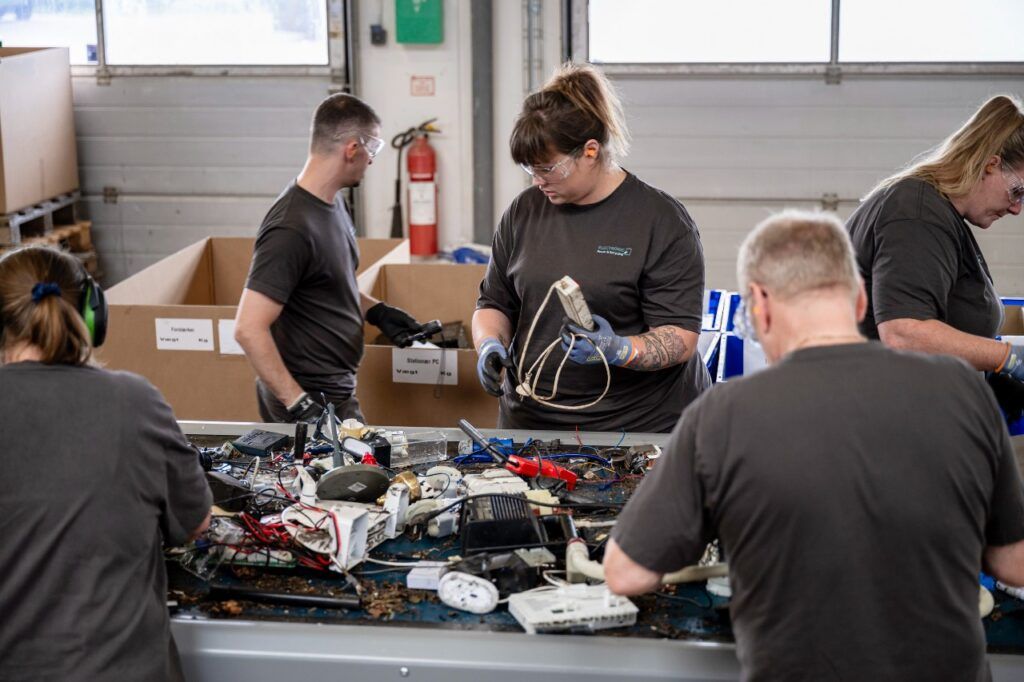
Photo: ERR and Kolorit
On 25 September, Denmark’s first facility for the reuse of electronics opens in Nørre Aaby on Funen. Here, 100,000 electronic products a year will be lifted out of the waste stream to be checked, repaired and tested – and ultimately put back on the market, sold as reused electronics.
The facility is called Electronic Reuse & Recycling (ERR) and has been established on the initiative of the Producer Responsibility Organisation Elretur as a joint venture with the recycling company HJHansen Recycling.
“Electronic Reuse & Recycling is the current culmination of the ambitious development in circular economy that the electronics industry has helped lead in Denmark in recent years. The facility is the first of its kind, and we have developed the concept behind it from the ground up. It is work that our colleagues and partners across Europe are following closely. The expectation is that ERR will become a reference facility, and that we will build up knowledge and expertise that others abroad will want to learn from,” says Morten Harboe-Jepsen, CEO of Elretur and Chair of the Board of Electronic Reuse and Recycling.
The costs of planning, development and, not least, establishment of ERR amount to a double-digit million figure. Elretur is governed through member democracy, and the major investment is being made precisely at the initiative of the organisation’s more than 1,000 member companies.
“The electronics industry is quite literally leading the way and delivering on something that many people talk about and want, but which is relatively difficult to make happen in practice: a large-scale effort that helps reduce the massive overconsumption of raw materials and resources that we are also responsible for here in Denmark. In this context, it is important to underline that this is happening on the industry’s own initiative, and that there is no legislation or political pressure acting as the underlying motivating factor. We are doing it because it makes sense,” says Morten Harboe-Jepsen.
With ERR, expertise is brought together in one place, where specialised staff can quickly identify electronics with reuse potential, and where experience can be translated directly into operations. At the same time, the facility is part of an ecosystem of repairers that take in the usable products and give them new life. This ensures efficient handling, high data security and as much direct reuse as possible.
“Now that the facility is operational, it should within a short time be able to finance itself through the sale of used electronics to repairers, who prepare the products so they can be placed on the market as reused products with an associated warranty,” says Mette Lilholm Lorenzen, Director of Electronic Reuse & Recycling.
At the heart of the facility are two sorting belts, each of which sorts around 30 cages per hour. ERR receives an average of 200 cages a day. Each cage contains approximately 175 kg of electronics.
“Our preliminary analyses show that 25% of the electronics have reuse potential, meaning that the product can be reintroduced to the market either directly or with a few simple repairs. Because we have such high volume at the facility, we can carry out better sorting, which means we can reuse even more product types than first assumed,” says Mette Lilholm Lorenzen.
To reduce the risk of fire, everything is kept under cover, and the facility has water reserves as well as thermal monitoring and fire alarms that react immediately if a temperature increase is detected. At the same time, all batteries are manually removed from the products.
“Our goal is to ensure that as much material as possible is preserved for direct reuse, so we extend product lifetimes and send more valuable resources back into the loop. That is why we have secured advanced technology and a high level of safety, enabling us to handle, sort and systematise large volumes of electronics safely and efficiently,” says Mette Lilholm Lorenzen.
The world is drowning in electronic waste.
According to the UN, 44 million tonnes of electronic waste were generated in 2014. By 2022, this had increased to 62 million tonnes, and by 2030, the amount of waste is expected to reach 82 million tonnes. Electronic waste is the world’s fastest-growing waste stream, and only 22% is documented as collected and prepared for reuse or recycled.
In Denmark, unfortunately, we contribute quite significantly to the waste stream. On average, each Dane discards 25 kg of electronic waste a year. That is 40% above the EU average and 210% above the global average.
“In Denmark, we are heavy users of electronics, and we have the world’s third-highest consumption of electronics. When you hold a podium position in a context like this, you also have a major responsibility to help lead the way. We must all take on that responsibility, because together we can make a difference. Globally, we are drowning in electronic waste, and we therefore need to change our habits,” says Morten Harboe-Jepsen.
Electronic Reuse and Recycling (ERR) is Denmark’s first and only reuse facility for small and medium-sized electronic waste. The facility, established in collaboration between Elretur and HJHansen Recycling, receives around 13,500 tonnes of electronics annually, which are sorted, repaired and reintroduced to the market with a full warranty.
ERR makes a significant contribution to the circular economy by extending the lifetime of up to 100,000 electronic products each year and supports the EU’s Critical Raw Materials Act (CRMA), which strengthens Europe’s security of supply and reduces dependence on imports. With advanced technology and increased safety, ERR sets a new standard for responsible reuse and recycling of electronics in Denmark and is an important driver of the green transition.
Located in Nørre Aaby on Funen and expects to employ around 30 people
Established by Elretur and HJHansen Recycling
Expected to save 100,000 small and medium-sized electronic products from the waste stream each year
Expected to receive and process 13,500 tonnes of electronics per year
Will receive an average of 200 cages of electronics a day and can sort up to 30 cages per hour per sorting line – two minutes per cage
Each cage weighs approximately 175 kg, and its contents are sorted in two minutes while moving down a 15-metre sorting belt
The expectation is that approximately 25% of the electronics can be reused
Each cage is equipped with a QR code, so it can be scanned to identify which site it comes from
Old batteries in electronics in particular pose a fire risk, which is why the facility has additional safety measures such as thermal monitoring
Electronics suitable for reuse are sold on to repairers, who prepare them so they can be sold as reused products with an associated warranty
At Elretur, we follow developments closely and make sure to keep you and our other member companies updated with relevant information and guidance.
This allows you to prepare your company as well as possible and avoid unnecessary surprises.
Keep an eye on our newsletter – sign up for Elretur News at www.elretur.dk.