New report: Electronics’ next life begins long before they become waste
A circuit board that no longer works. An electronic component that needs replacing. A product that has become too expensive or difficult to repair.
When electronic products are no longer in use, valuable materials can still be recycled. But some of the product's value may already have been lost long before it reaches that point.
The potential to give electronics a new life depends not only on what happens when products become waste. It is also shaped by the decisions made when electronics are designed, manufactured and used.
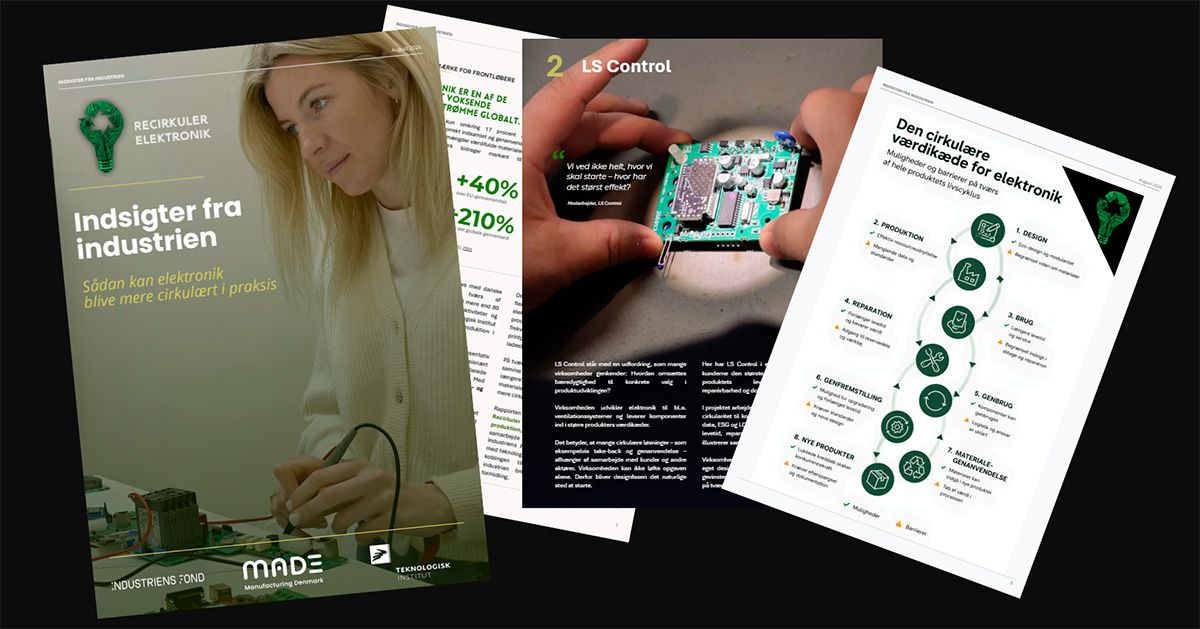
This is one of the key messages of the report Insights from Industry: How to Make Electronics More Circular in Practice, prepared by MADE and the Danish Technological Institute as part of the Recirkuler Elektronik project.
For Poul Poulsen, Acting Managing Director of Retur, of which Elretur is a part, the report highlights an important connection between decisions made early in a product's life and the opportunities to preserve its value later on.
“If we want more circular electronics, we need to consider the entire product lifecycle. It starts at the design stage, where decisions are made that can have a major impact on whether products can later be repaired, reused or recycled. This is a connection we also work with at Elretur,” says Poul Poulsen.
The report is based on 19 interviews with Danish manufacturing companies and dialogue with more than 80 businesses. It brings together experiences relating to product design, repair, servicing and circular business models.
One of the report's central findings is that extending the lifespan of electronics through servicing, maintenance and repair often creates greater circular value than focusing on recovering materials only once products have reached the end of their useful life. Keeping products in use for longer also preserves the value and resources already invested in their manufacture.
However, this requires products to be designed with a longer lifespan in mind. And this is where trade-offs can arise.
For example, a product may be designed to be robust and resistant to water and dust, while at the same time being difficult to open and repair. Even if a component can technically be replaced, doing so also requires access to spare parts and knowledge of how the product is constructed.
The report also points out that technical possibilities alone are not enough. Financial considerations, documentation, organisation and collaboration between companies can determine whether circular solutions are actually put into practice.
It is therefore not only about developing products that last longer, but also about creating the conditions that allow them to be repaired and reused before eventually being sent for recycling.
See also: New Report on Fast Tech: The Throwaway Culture Has Taken Over Electronics
While the report examines how companies can create better conditions for circularity through design, production and new working practices, Elretur works to preserve the value of electronics once they have become waste.
At the Electronic Reuse and Recycling facility, operated by Elretur and HJHansen, electronic waste is inspected to identify products that still have the potential to be used again.
These products are recovered from the waste stream, prepared and repaired where necessary, allowing them to be placed back on the market with a warranty.
Electronics that cannot be given a new life are sent for recycling, where their materials can be recovered for use in new products.
“Every day, we see that electronics are not necessarily at the end of their useful life simply because they have been discarded as waste. When we can recover products from the waste stream and give them a new life, we preserve much more of the value that has already gone into manufacturing them. And when products can no longer be used, we must of course ensure that their materials are recycled,” says Poul Poulsen.
The work carried out at the facility also illustrates one of the connections highlighted in the report: the opportunities to preserve the value of electronics depend in part on the decisions made when the products were originally developed.
The need for a more circular approach to electronics is also a current issue at European level.
The European Commission is assessing the need to revise the WEEE Directive, which establishes the framework for extended producer responsibility for electrical and electronic equipment.
In its 2025 evaluation, the Commission points out, among other things, that the directive has had only a limited impact on preventing electronic waste and promoting preparation for reuse. At the same time, the current rules provide only limited incentives for more sustainable product design.
The evaluation also highlights challenges relating to the collection and treatment of electronic waste, as well as the recovery of critical raw materials.
No new requirements have yet been adopted as a result of the potential revision, but these developments are relevant to Elretur's members because they may affect the future framework for extended producer responsibility and efforts to preserve the resources contained in electronics.
Read more: The EU amp up the race for raw materials: Producer responsibility could take on a new strategic role
One of the report's key messages is that circular solutions depend on more than technical feasibility. They must also work in practice and be economically viable.
The report therefore highlights the importance of testing specific, clearly defined initiatives that allow companies to gain experience and identify solutions that can work on a larger scale.
For Elretur's members that manufacture or import electronics, the report's insights are already relevant. Repairability, access to spare parts and documentation of product composition are not only matters of circularity. They are also issues that are becoming increasingly important as EU product and environmental legislation develops.
At the same time, developments within the EU underline why manufacturers and importers have good reason to consider, already now, how their products can last longer, be repaired and ultimately be managed when they become waste.
For Elretur, the aim is to turn circular thinking into practical solutions that preserve as much value as possible in electronics. This is precisely the ambition behind the work carried out at Electronic Reuse and Recycling.
“For us, it is about making the most of the resources already contained in products. That is why we work both to give electronics a new life and to ensure that materials are recycled when products can no longer be used. These are two sides of the same task, and this is how we make a tangible contribution to a more circular electronics sector,” says Poul Poulsen.
The report was prepared as part of the Recirkuler Elektronik project, carried out by the Danish Technological Institute and MADE with support from the Danish Industry Foundation (Industriens Fond).
Read the report: Insights from Industry – Circular Electronics (in Danish)