New information: How the Danish legislative process for extended producer responsibility for textiles is expected to unfold

There may soon be greater clarity on the Danish rules for extended producer responsibility (EPR) for textiles.
Tekstilretur has gained insight into the expected timeline for the Danish legislation on producer responsibility for textiles.
According to the information received, the legislation is expected to be discussed by the government's Green Committee before Christmas, followed by a technical briefing for spokespersons from all parties represented in the Danish Parliament in January. Draft amendments to the Environmental Protection Act and a new executive order are expected to be submitted for public consultation by March 2027 at the latest.
The timeline has not yet been officially confirmed, but it provides a preliminary indication of when the textile industry can expect greater insight into the upcoming Danish regulations.
“It is encouraging that a timeline for the Danish legislative process is now beginning to take shape. Businesses need to know when they can expect greater clarity on the rules they will have to prepare for,” says Camilla Jonassen, Subject Matter Expert at Tekstilretur, which is part of the Retur family.
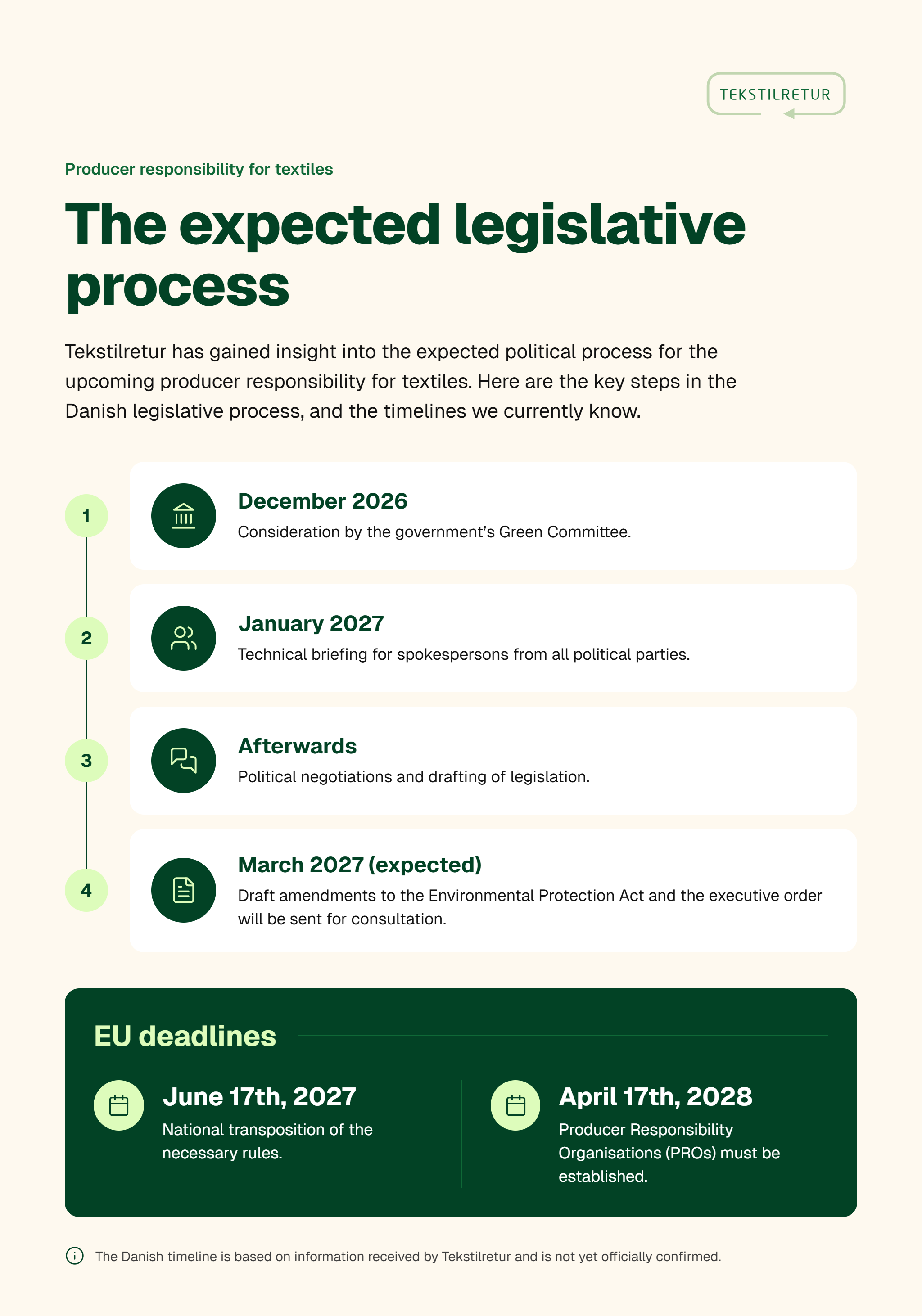
The first step is expected to be a discussion in the government's Green Committee before the end of 2026. The Green Committee consists of ministers from eight different ministries.
The committee deals with government policy on issues including climate, nature and the environment, and normally meets once a week.
This is expected to be followed by a technical briefing for spokespersons from all political parties represented in the Danish Parliament in January 2027.
The purpose of the technical briefing is to provide politicians with insight into the legislative and practical aspects of the proposed rules. It will serve as a basis for the spokespersons to discuss the legislation within their respective parties and establish their parties' positions.
The process will then continue with political negotiations and further legislative work.
Implementing producer responsibility for textiles requires both an amendment to the Danish Environmental Protection Act and the issuance of a new executive order. Both must undergo public consultation before they can be adopted.
According to Tekstilretur's information, the public consultations are expected to begin by March 2027 at the latest, and the consultation period is expected to be shorter than usual.
Although producer responsibility for textiles is set out in the EU Waste Framework Directive, the provisions are not yet applicable as national requirements in Denmark. This is because the legislation takes the form of a directive rather than a regulation.
An amendment to the Danish Environmental Protection Act is therefore necessary to authorise the Minister for Climate, Energy and Utilities to establish the detailed rules on producer responsibility through an executive order.
“The public consultation is an important milestone for everyone affected by extended producer responsibility for textiles. This is when we will really have the opportunity to see how the rules will be implemented in Denmark and what consequences they will have for businesses,” says Camilla Jonassen.
The expected Danish timeline must be viewed in light of the EU deadlines for implementing extended producer responsibility for textiles.
Denmark must transpose the necessary rules into national legislation by June 17th, 2027, while Producer Responsibility Organisations (PROs) must be established by April 17th, 2028.
Although some of our Scandinavian neighbours do not expect to meet the deadline, the message from Denmark is that the country intends to implement producer responsibility on time.
The coming months will therefore be crucial in determining how quickly businesses gain clarity on the Danish regulatory framework.
“There is not much time left before producer responsibility must be in place. That is why we at Tekstilretur are working to help businesses gain clarity on their obligations as quickly as possible, so they have sufficient time to prepare,” says Camilla Jonassen.
Tekstilretur is closely monitoring the process and will keep its members informed as further details about the Danish implementation become available.
“When the new rules are submitted for public consultation, we will inform our members and invite them to contribute to Tekstilretur's consultation response. It is important that our response reflects the real challenges businesses face in practice, and we therefore look forward to involving our members in the process,” says Camilla Jonassen.
By pre-registering with Tekstilretur, your company gains easy access to knowledge, updates and guidance as the regulatory framework takes shape.
This makes it easier to start preparing now, without having to wait for the Danish executive order.
As a member of Tekstilretur, you benefit from:
Pre-registration is free of charge and non-binding until implementation.
If your company is already a member of another producer responsibility scheme within the Retur family, your future Tekstilretur membership fee is included at no additional cost.