Tekstilretur highlights producer responsibility in the development of Denmark’s national textile action plan
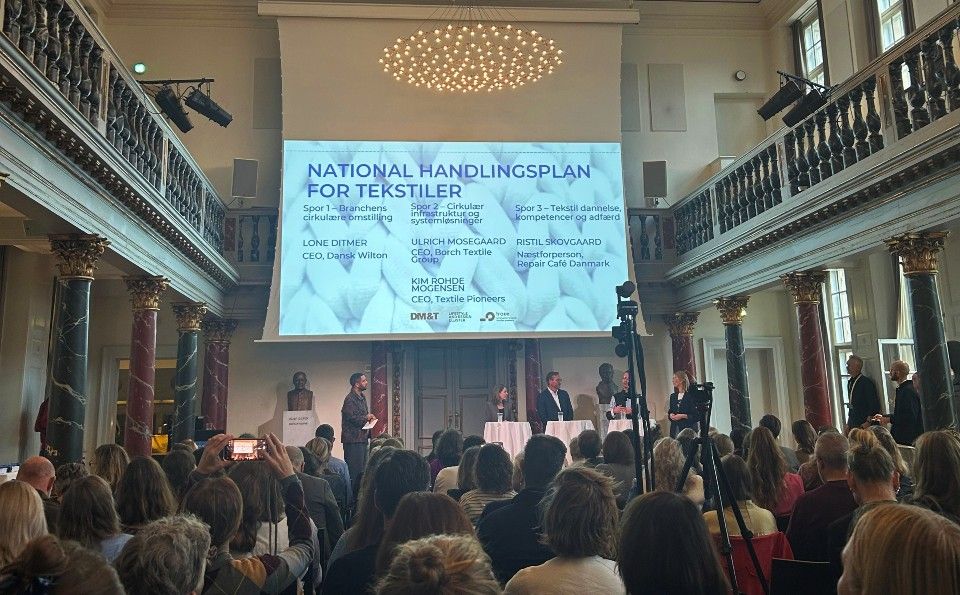
Denmark's national textile action plan is moving from ambitions towards concrete activities.
At three workshops in Copenhagen, Odense and Aarhus, stakeholders from across the textile sector contributed input on how the initiatives should be designed before the upcoming projects are put out to tender.
For Tekstilretur, represented at all three workshops by Subject Matter Expert Camilla Jonassen, one connection is particularly important: the solutions being developed now could have a direct impact on both companies' administrative workloads and the future costs of extended producer responsibility (EPR).
Read also: National action plan to shape the future of the textile sector
The upcoming extended producer responsibility will introduce new requirements for textile companies. These include registration, reporting and documentation, while new EU ecodesign requirements are also on the horizon.
One of the action plan's initiatives will therefore develop EU readiness packages containing practical tools and training programmes to help companies navigate the regulations. This is particularly important for the many smaller businesses in the textile industry, which may not have the resources to handle extensive administrative tasks.
"We know from other producer responsibilities that navigating new regulations can be complicated. Documentation and data are necessary, but we need to help companies spend as little time as possible on administration. Their energy would be better spent accelerating the transition to a circular economy," says Camilla Jonassen, Subject Matter Expert at Retur.
Tekstilretur will be able to contribute experience from other producer responsibility schemes and work to ensure that the tools are practical and useful in companies' day-to-day operations.
While companies prepare for new requirements, significant questions remain about what happens to textiles covered by producer responsibility once they become waste.
What quantities are involved? What is the quality of the textiles? And where do they go after collection?
An updated national textile flow analysis aims to provide better answers. Building on the Danish Environmental Protection Agency's 2018 mapping study, the analysis will establish a shared data foundation for future textile waste management.
Tekstilretur is particularly calling for more information about the volumes of textiles handled by charitable organisations.
"We particularly lack insight into the quantities and quality of textiles handled by charitable organisations. The better we understand textile flows, the better we can assess what kind of waste management we need to prepare for and what it will cost producers," says Camilla Jonassen.
At the same time, a new dialogue forum will bring together producers, municipalities, producer responsibility organisations, and waste management and reuse operators, among others, to discuss the practical aspects of producer responsibility.
Tekstilretur sees this as an opportunity to share experiences and gain a better understanding of the challenges faced by other stakeholders. This could be crucial to minimising initial difficulties when the producer responsibility scheme is implemented.
Knowledge of textile flows will also provide the foundation for decisions about future textile infrastructure.
One of the action plan's initiatives will examine where additional capacity is needed for sorting, repair, reuse and recycling, and which solutions would be most economically viable to develop in Denmark or in collaboration with other European countries.
However, investments must be aligned with textile volumes, material quality, available technology, demand and financial viability.
This is particularly relevant because, under the upcoming producer responsibility, producers will be required to finance the management of textile waste.
"Of course, we should aim to manage textiles as high up the waste hierarchy as possible. But the solutions must also work in practice and on a large scale. There needs to be a genuine business case behind investments, and we must ensure the greatest possible environmental benefit for the money spent," says Camilla Jonassen.
Producer responsibility organisations such as Tekstilretur could ultimately play a central role in implementing the recommendations, either through direct investment or by tendering waste management services.
It is therefore essential that the solutions taken forward are not only technically feasible but can also be operated cost-effectively.
The three workshops form part of a market dialogue intended to inform and improve the action plan's upcoming tenders.
Work on the first initiatives is expected to begin in 2027, ahead of the producer responsibility scheme, which is currently scheduled to be established by April 2028 at the latest.
For Tekstilretur, it is important that dialogue between stakeholders continues throughout the process.
"We bring Retur's experience with producer responsibility from other sectors, but we are equally committed to listening. The better we understand each other's tasks and challenges across the value chain, the better we can prepare. This dialogue and proactive planning can save us a lot of headaches later on," says Camilla Jonassen.
The action plan also includes initiatives focusing on repair and broader public awareness of textiles.
Producer responsibility organisations may have a role in fulfilling information obligations in this area, but Tekstilretur is awaiting the Danish implementation of the regulations before its specific role can be assessed.
For now, the priority is to establish the best possible foundation for future decisions, ensuring that the transition to a circular textile economy is not just about ambitions, but also about solutions that will work when producer responsibility becomes a reality.