1. Home
  2. emballageretur
  3. Eco-modulated fees for packaging

Eco-modulated fees for packaging - what are they, and what do they mean for your company?

The fee you pay for packaging does not only depend on quantities and materials. Packaging design and documentation also matter. Here you get an overview of how eco-modulation works and what it requires from you in practice.

Eco-modulation links packaging design and economics

Eco-modulated fees are a statutory pricing model for packaging based on a bonus/malus principle. The model makes it cheaper to place packaging on the market when it is easy to recycle (green classification), and correspondingly more expensive to place packaging on the market when it has a high environmental impact (red classification).

The model functions as a closed financial loop within each material category. This means that the additional costs from red-level packaging finance the discount for green-level packaging. In other words, it is a redistribution between producers - not an additional authority fee.

In Emballageretur's model, packaging at red level is charged an additional 35% on top of the operational costs. The additional amount collected is redistributed to producers with packaging at green and/or yellow level. Producers with packaging at green or yellow level must pay at least 20% of the operational costs.

If you choose not to eco-modulate your packaging, or if you do not have the correct documentation, it will generally be placed at red level.

The three levels

Green level

Packaging with low environmental impact.

Yellow level

Packaging with moderate environmental impact.

Red level

Packaging with high environmental impact. At this level, an additional cost of 35% of the operational costs is paid for the packaging in question.

Which materials are covered by eco-modulation?

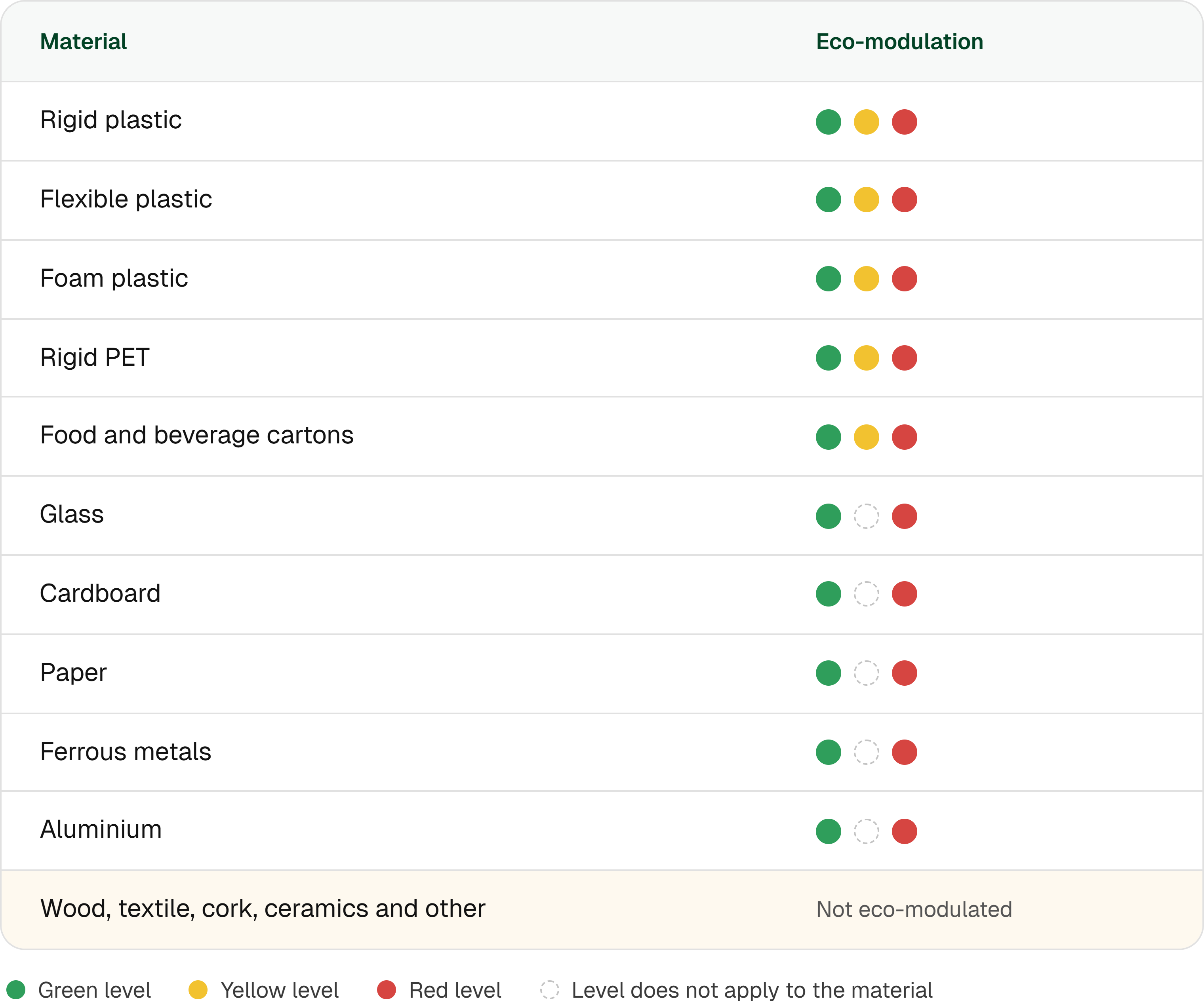
Eco-modulation does not apply to all packaging types, and the requirements differ depending on the material type. Some materials are divided into three levels, while others are divided into only two. In addition, some materials are not eco-modulated.

Materials with green, yellow and red level classification

For rigid plastic, flexible plastic, foam plastic, rigid PET and food and beverage cartons, packaging is generally assessed at three levels: green, yellow or red.

Materials with green and red level classification

For glass, cardboard, paper, ferrous metals and aluminium, packaging is generally assessed at two levels: green or red.

Materials that are not eco-modulated

Wood, textile, cork, ceramics and other materials are not eco-modulated. They may still be covered by EPR and must still be reported, but they are not placed in green, yellow or red according to the eco-modulation model.

Certain types of packaging are also exempt from eco-modulation, even though they are still covered by EPR. This applies, among other things, to contact-sensitive packaging for medicinal products, medical devices, packaging in direct contact with food and packaging for dangerous goods.

Documentation determines whether you can be placed in green or yellow

To achieve green or yellow level, you must be able to document that the packaging meets the relevant design requirements. If the documentation cannot be provided, the packaging is placed at red level.

The documentation will typically come from your packaging supplier and may include product sheets, material specifications, test results and certificates. The work is often greatest when the data basis is first established, but the documentation must be maintained on an ongoing basis when packaging, suppliers or product ranges change. You must be able to present the documentation to the authorities or your PRO at any time.

The components of the packaging may need to be assessed differently

If packaging consists of several materials or components, whether the parts can be separated and how they function together may affect the eco-modulation.

In some cases, the packaging must be assessed as one combined unit. In other cases, individual components must be assessed separately if they can be separated and affect the material category or design requirements of the packaging.

This means that eco-modulation is not only about knowing the total weight of the packaging. You must also be able to document which materials and components the packaging consists of, and how they form part of the overall packaging.

Stay ahead of new EU requirements

The Packaging and Packaging Waste Regulation (PPWR) and eco-modulated fees are making data documentation a strategic business issue.

With Emballageretur, you get a partner that follows regulatory developments closely. We give you access to the knowledge you need on packaging design and supplier requirements, so your company is prepared to build the right data foundation as stricter EU requirements come into force.

Why companies actively work with eco-modulation

Eco-modulation is not only a question of compliance. It is also a management tool, because packaging design and economics are directly linked. If you work systematically with packaging choices and documentation, it can affect both your fees and the recyclability of your packaging.

With the Packaging and Packaging Waste Regulation (PPWR), packaging design requirements will gradually become stricter towards 2030. Companies that already work systematically with packaging data and supplier documentation will therefore be in a stronger position when meeting the upcoming requirements.

Frequently asked questions

Eco-modulated fees for packaging